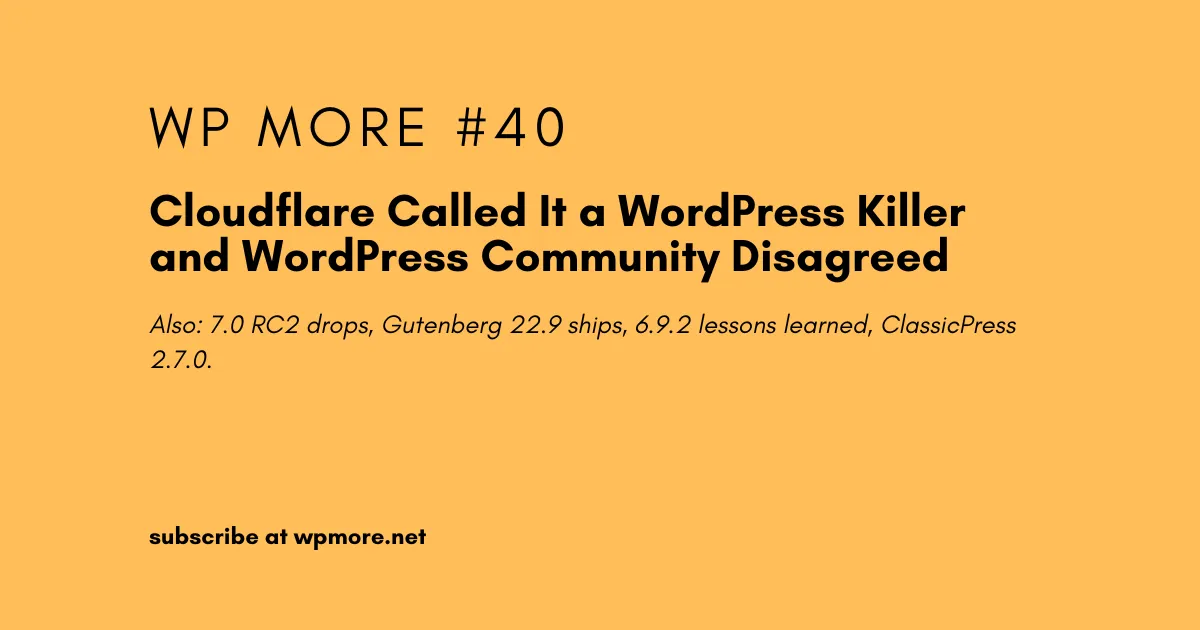
Also: 7.0 RC2 drops, Gutenberg 22.9 ships, 6.9.2 lessons learned, ClassicPress 2.7.0.
Hello WordPressers!
Welcome to this week’s WordPress roundup — WP More newsletter issue 40, where you get curated news about WordPress and the WordPress community all in one place.
WordPress 7.0 is close enough to touch and the ecosystem around it has been buzzing. This week we’re covering the final stretch of the 7.0 release cycle, a Gutenberg update packed with collaboration fixes, some hard lessons from the 6.9.2 security release, a challenger CMS that’s got everyone talking, and a quiet but solid update from ClassicPress.
Lots to dig into.
In this Issue:
- WordPress 7.0 Is Almost Ready, Here’s How to Test It
- Gutenberg 22.9 Brings Gradient Overlays, Better Collaboration, and More
- The 6.9.2 Security Release Didn’t Go Smoothly, Here’s What the Team Learned
- Cloudflare Launched a “WordPress Spiritual Successor” and The Community Wasn’t Buying It
- ClassicPress 2.7.0 Is Out , With Speed Boosts You’ll Actually Notice
WordPress 7.0 Is Almost Ready, Here’s How to Test It
The second Release Candidate for WordPress 7.0 is out, which means the final release is right around the corner. RC2 dropped ahead of the scheduled, and the core team is asking the community to help with one last round of testing before it ships.
You can test it four ways: install the WordPress Beta Tester plugin, download the RC2 zip directly, use WP-CLI (wp core update --version=7.0-RC2), or try it instantly in your browser via WordPress Playground — no setup required.
Two areas the team specifically wants eyes on: Real Time Collaboration and Pattern Editing with content-only interactivity. If you find a bug, report it on the support forums or directly on Trac.
This is also the point where plugin and theme authors should wrap up their compatibility testing and update the “Tested up to” value in their readme files to 7.0.
- RC2 marks a hard string freeze — translations need to be finalized now.
- WordPress Playground makes testing dead simple, even if you don’t have a test server handy.
Read the full blog on Official WordPress blog here.
Speaking of what’s going into 7.0, the Gutenberg project just shipped a release that gives us a clearer picture of what’s coming.
Gutenberg 22.9 Brings Gradient Overlays, Better Collaboration, and More
Gutenberg 22.9 is out, and it’s a tidy release with a few highlights worth knowing about. The Group block now supports background gradients alongside background images, meaning you can finally layer a gradient overlay on top of a photo without workarounds. A new gradient picker appears in the Background panel and works independently of existing color controls.
The command palette (Cmd+K / Ctrl+K) is getting an experimental upgrade too: it now shows sections for recently used commands and contextual suggestions, making it easier to find actions quickly. To try it, enable “Workflow Palette” under WP-Admin > Gutenberg > Experiments.
Real-time collaboration also got meaningful stability improvements. Block comments now sync properly between editors without requiring a page refresh, and the “Join” button in the post list correctly reverts to “Edit” when a collaboration lock expires. A handful of behind-the-scenes fixes also prevent memory issues during collaborative sessions.
- 131 pull requests merged, with 5 first-time contributors.
- A new
EmptyStatecomponent was added to thewordpress/uipackage for consistent placeholder UI patterns. - The experimental Forms block now supports hidden input fields.
Read the full blog on Official Make WordPress blog here.
Before we get too excited about what’s new, there’s an important post-mortem worth reading about what went wrong last month.
The 6.9.2 Security Release Didn’t Go Smoothly, Here’s What the Team Learned
The WordPress 6.9.2 security release in March had a rough rollout, and the Security Team has published a candid retrospective about it. The short version: a bug fix triggered a fast-follow 6.9.3 release just eight hours later, three security commits were accidentally left out of the original 6.9.2 package (leading to a 6.9.4), and backporting fixes to 22 older branches turned out to be a slow, labor-intensive process.
The good news is that the team has identified concrete fixes. The minor release checklist will be updated to include double-verification of merge commits, clearer steps for releasing during a beta phase, and better documentation throughout. On the technical side, backport tooling and automation are being improved to reduce the manual burden.
There’s also a longer-term question on the table: Matt Mullenweg has asked what AI-assisted tooling could help review changes going into releases and improve quality control. No specifics yet, but it’s being explored.
- A checklist gap – no step to independently verify all commits made it into the branch, caused the missing fixes in 6.9.2.
- The 6.0 branch (version 6.0.12) remains unreleased at the time of writing due to an unresolved build issue.
- Backporting to 22 branches is increasingly unsustainable without better automation.
Read the full blog on Official Make WordPress blog here.
While the WordPress team was working through its own growing pains, a newcomer arrived claiming to pick up WordPress’s mantle and the community had thoughts.
Cloudflare Launched a “WordPress Spiritual Successor” and The Community Wasn’t Buying It
Cloudflare released a new CMS called EmDash on April 1, not a joke, billing it as a “spiritual successor to WordPress.” Built on TypeScript and Astro 6.0, running serverless on Cloudflare Workers, and licensed under MIT, it was built in roughly two months with heavy AI assistance. Its headline claim: plugins run in isolated sandboxes, solving the plugin security problem.
Matt Mullenweg pushed back firmly, arguing that WordPress’s spirit is about democratization, running anywhere, on any host, with no lock-in. Critics across the community echoed that point: EmDash’s sandboxed plugin model only works on Cloudflare’s infrastructure, which is a hard limit for anyone hoping to see it adopted at WordPress’s scale.
Others pointed out that the editing interface felt dated (it uses TipTap, not Gutenberg), that it lacks site editing capabilities, and that it’s built almost entirely for developers, leaving out the bloggers, small business owners, and content managers who make up most of WordPress’s actual user base.
- Joost de Valk (Yoast founder) praised EmDash as a CMS “built for 2026,” particularly for AI-assisted development workflows.
- WordPress CMS market share has dipped below 43% for the first time since 2022, making the broader conversation about alternatives more relevant.
- Mullenweg said he expects plugin security to be addressed in WordPress itself within 18 months, with the help of AI.
Read the full report on The Repository here.
Other reports from The Repository you might like to read:
- The Admin Bar’s 2026 Agency Survey Shows Growth Slowing and Passive Marketing at Its Limit
- The WP Community Collective Publishes Open Source Contributor Pay Standard
- Roots Launches WP Composer as Open Source Alternative to WPackagist
Don’t forget to subscribe & support them, they do some amazing hard-hitting WordPress journalism.
And finally, a quieter but genuinely useful update from the WordPress fork that keeps things classic.
ClassicPress 2.7.0 Is Out , With Speed Boosts You’ll Actually Notice
The two headline features are view transitions in the admin (navigation between pages now feels smoother, closer to a single-page app experience) and a built-in object cache option under Settings > Reading. When enabled, the object cache reduces database queries significantly and speeds up your site for both logged-in and logged-out users, something page caching alone can’t do. It requires your host to support the APCu module, and ClassicPress will tell you if yours doesn’t.
The Text widget was also completely rewritten in vanilla JavaScript, dropping jQuery and Backbone.js dependencies. That’s part of ClassicPress’s ongoing effort to remove outdated libraries and improve performance across the board. Translation loading also got faster, which will be noticeable on non-English sites.
- Object caching works alongside other caching methods like OpCache and page caching, they’re not mutually exclusive.
- The jQuery removal in the Text widget is part of a longer-term modernization project.
- Version 2.7.0 also includes security fixes and library dependency updates.
Read the full announcement on Official blog here.
WordPress Must Read
→ WordPress 7.0 AI Connectors: Pros, Cons, and What the Ecosystem Needs to Get Right (vapvarun.com)
→ WooCommerce Data Insights, 2026 Edition (studiowombat.com)
→ WordPress 7.0 Source of Truth (gutenbergtimes.com)
→ The Lifespan Of SSL Certificates Is Shrinking, And Agencies Must Adapt (forbes.com)
→ State of the WordPress Agency 2026 (theadminbar.com)
→ WordPress Is Colliding With AI — and Nobody Had ‘None’ on Their Bingo Card (therepository.email)
→ Do you need a CMS? (joost.blog)
→ The Risk of Software Dependency (zant.com)
→ Building WordPress plugins in context (mattcohen.co)
→ AI Featured Images (darinkotter.com)
On other WordPress News
→ @wordpress/build, the next generation of WordPress plugin build tooling (developer.wordpress.org)
→ Monthly Education Buzz Report – March 2026 (make.wordpress.org)
→ Introducing the WordPress Facilitator Training Program (make.wordpress.org)
→ Community Summit alongside a flagship event for 2027 or 2028 (make.wordpress.org)
→ Building a custom sync provider for real-time collaboration (make.wordpress.org)
→ How WordPress 7.0 Is Building the Foundation for AI-Powered Sites (wordpress.com)
→ New in WordPress Studio: Studio CLI on npm & phpMyAdmin Access (wordpress.com)
→ The Path Forward for WordPress 7.0 (make.wordpress.org)
→ 2026 Community Team Reps (make.wordpress.org)
→ WordPress Studio now has an independently installable CLI (x.com)
→ Announcing the Training Team Cohort: “Block Theme Development in WordPress” (make.wordpress.org)
→ WordCamp Creator Studio, Sponsored by WordPress.com: Available for Sign Ups Now! (asia.wordcamp.org)
→ Rethinking Left Navigation (make.wordpress.org)
→ Plugin Directory MCP Server (make.wordpress.org)
→ Guidelines Lands in Gutenberg 22.7 (make.wordpress.org)
→ What’s new in AI 0.6.0 (20 MAR 2026)? (make.wordpress.org)
→ Call for Testing: Community AI Connector Plugins (make.wordpress.org)
→ Contribute to the Plugins Team! (make.wordpress.org)
→ Introducing the Connectors API in WordPress 7.0 (make.wordpress.org)
→ Twenty Twenty-Seven default theme: Call for Volunteers (make.wordpress.org)
→ Connect AI coding agents to WordPress Playground with MCP (make.wordpress.org)
→ Plugin Directory: Local Development Environment (make.wordpress.org)
From WordPress Community
→ Checkout Summit {Reloaded} – The first independent online conference for WooCommerce builders, founders, and agencies (checkoutsummit.com)
→ Alina Kakshapati receives the Yoast Care fund for her contribution to the WordPress community (yoast.com)
→ Joan Namunina receives the Yoast Care fund for her contribution to the WordPress community (yoast.com)
→ WP Packages is Working the Way Open Source Should (wordpress.org)
→ WP Engine Announces DE{CODE} 2026: Shape What’s Next (wpengine.com)
→ Akramul Hasan receives the Yoast Care fund for his contribution to the WordPress community (yoast.com)
→ Organizing Asia’s Biggest WordPress Gathering: A Conversation with the WordCamp Asia 2026 Event Leads (wp-content.co)
→ #WCEU2026 – Community That Shapes WordCamp Europe (youtube.com)
→ WordPress Campus Connect Jinja 2025 Recap: Piloting Africa’s First and Largest Campus Connect Program Across 12 Campuses in Eastern Uganda (central.wordcamp.org)
→ Introducing EmDash — the spiritual successor to WordPress that solves plugin security (cloudflare.com)
→ EmDash Feedback (ma.tt)
→ AI for Nearly a Billion (j.cv)
→ #209 – Simon Pollard on Navigating the New Normal for WordPress Community and Events (wptavern.com)
Conclusion
That’s your WP More roundup for this week. Whether you’re testing WordPress 7.0 RC2, watching the EmDash conversation unfold, or just quietly appreciating a ClassicPress object cache, there’s a lot happening in this corner of the web.
If something here sparked a thought, hit reply; we read every message. And if a friend or colleague would find this useful, feel free to pass it along.
Nishat, WP More
Follow → X.com | LinkedIn | BlueSky | Facebook
Join Our Community → Sub-Reddit | X Community