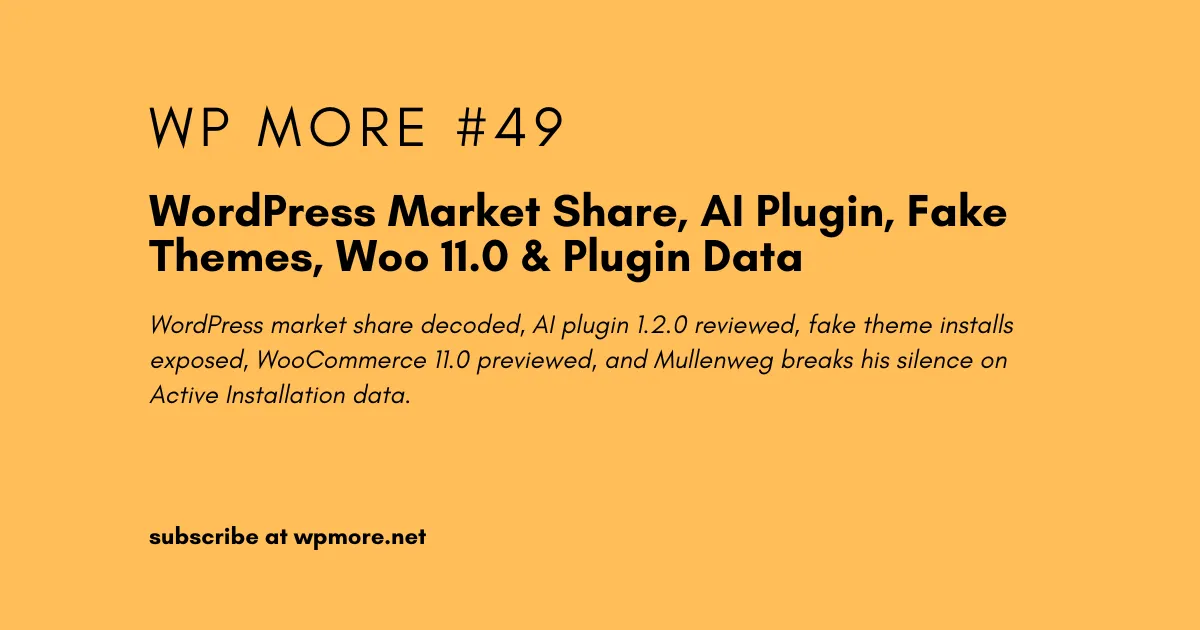
WordPress market share decoded, AI plugin 1.2.0 reviewed, fake theme installs exposed, WooCommerce 11.0 previewed, and Mullenweg breaks his silence on Active Installation data.
Hello WordPressers!
Welcome to this week’s WP More roundup – WP More newsletter issue 49, where you get curated news about WordPress and the WordPress community all in one place.
Five stories this week, and they share a thread: who controls WordPress data, who benefits from it, and who gets left out.
In this Issue:
- WordPress lost market share – here’s why that’s not the full story
- WordPress AI plugin 1.2.0 is out with useful new features
- Fake installs have been gaming the WordPress.org popular themes list for two years
- WooCommerce 11.0 is coming with performance and developer improvements
- Matt Mullenweg finally responded to the active install data ticket – sort of
WordPress Lost Market Share and Got Stronger
WordPress slipped from 43.6% to 41.5% of all websites. But at the top of the web – the 10,000 most-visited sites – it holds around 58% of CMS usage. Wix and Shopify are barely present there at all.
MemberPress growth manager Curt Noble argues the dip tracks with Google’s spam crackdowns since March 2024, which wiped out thousands of made-for-SEO WordPress sites. When junk sites fall out of the measured web and aren’t replaced, headline share drops even if no real business left. Meanwhile, US search interest in WordPress just hit a five-year high, with buying-intent queries like “WordPress development company” up 450%. WordPress 7.0 shipped native AI infrastructure too – an AI Client, Abilities API, and MCP Adapter – making it the first major CMS that AI agents can operate directly.
The AI infrastructure story goes deeper in the next one.
WordPress AI Plugin 1.2.0: What’s New
Version 1.2.0 landed on July 14. The headline addition is “Suggest Reply” for comment moderation – moderators generate contextual replies from the Comments screen or Activity widget, choosing from friendly, professional, or casual tones. Each suggestion is editable before it goes live, so a human still makes the call.
Bulk content summarization is also new: select multiple posts from the list table, hit generate, and summaries are created without opening each item. Two new read-only Abilities landed – core/read-content and core/read-users – giving AI agents structured, permission-checked access to WordPress content and user data. Settings got simplified, type-ahead text got several fixes, and accessibility improved. Version 1.3.0 is already in progress, with content translations and media editor integration on the roadmap.
Read more on WordPress Make Blog →
While WordPress adds tools for legitimate publishers, some theme authors have been running a different kind of operation.
Fake Installs Have Been Gaming the Popular Themes List for Two Years
Theme developer Pavel Ciorici has spent two years documenting something that doesn’t add up on WordPress.org: a group of themes gaining thousands of “active installs” in days while being downloaded around 20 times per day. A theme gaining 6,000 net new active sites in a week on 140 total downloads is not a measurement artifact. It’s arithmetically impossible.
Themes like Envo Royal, Envo One, and Futurio move together – gaining or losing 15 to 20 ranking positions on the same day, across accounts claiming to be separate authors. A reverse analytics lookup found several of those vendors sharing one Google Analytics ID. When Envo Royal pushed a cosmetic update, it generated 1,400 downloads against a claimed 30,000 active installs. Ciorici reported this from September 2024 onward. WordPress.org’s response: “the data looks real.” The numbers were quietly reset in May 2026. Five weeks later they were climbing again.
The plugin directory has its own version of this data trust problem, and it’s been running even longer.
WooCommerce 11.0: What Developers Should Know
WooCommerce 11.0 is in beta, with final release on July 28. Performance for larger stores is the clear focus – 28 pull requests cover performance, caching, or scalability. Product object caching is on by default for new stores, cutting variable product load times by 9 to 12% and bundle checkout processing by 6 to 12%.
Customer-side, 11.0 adds an email verification path so logged-in customers can connect past guest orders to their account. Analytics imports now show failed jobs with a retry option, and the v3 sales report gains a refunds field per date bucket for more accurate net-sales figures. Developers: the Product Editor beta is being retired here – return to the classic editor and audit your code for removed packages. Two new phone hooks also land: woocommerce_validate_phone and woocommerce_format_phone_number.
Read more on WooCommerce Developer Blog →
Speaking of data developers can’t see – the plugin directory fight over active install charts finally got a response.
Brought to you by
WP More Socials
I send this newsletter every week, but do you want to keep up with WordPress and the community?
Then follow WP More’s social profile.
X (formerly Twitter) – https://x.com/WPMoree
LinkedIn – https://www.linkedin.com/company/wordpress-more/
BlueSky – https://bsky.app/profile/wpmore.bsky.social
I post there every day. So, you are not going to miss anything.
Follow WP More, Stay Updated with WordPress!
Mullenweg Responds to Plugin Data Ticket – After Four Years
In September 2022, WordPress.org removed the active install growth charts from the plugin directory. These were the only tool developers had for tracking whether their plugins were gaining or losing users between coarse install milestones like “10,000+”. Four years and 178 ticket comments later, Matt Mullenweg posted his first response.
He cited “competing interests” and the long-term incentives of commercial versus community plugins. No timeline, no commitment to restore the data. Developers noticed the reasoning had shifted: in 2022, it was framed as a privacy issue; now it reads as a policy decision. Former Automattic employee Mark Riley put it plainly – Automattic sees the install data, plugin developers don’t, and that asymmetry shapes product decisions. Meanwhile, the community built wp-rankings.com to reconstruct the missing charts from four years of API snapshots. The site drew 72,000 unique visitors in 24 hours after launching V2. Mullenweg has not followed up.
WordPress Must Read
→ Security Researcher Used OpenAI’s Sol Ultra to Find WordPress’s Worst Vulnerability in Years (therepository.email)
→ The ACF Annual Survey 2026 is here (advancedcustomfields.com) – Share your feedback and help shape the future of ACF.
→ Help Shape the Future of PHP: Take the State of PHP Survey (thephp.foundation)
→ Ecommerce platform market share 2026: WooCommerce leads the web, Shopify leads the top tier (gravitykit.com)
→ The WordPress plugin install boom is over (linkedin.com)
→ Most installed plugin list from plugin data from 80,000 WordPress sites managed by agencies on WP Umbrella (linkedin.com)
On Other WordPress News
→ WordPress 7.1 Beta 3 is ready for download and testing! (wordpress.org)
→ Help shape the next chapter of WP Credits: a developer track, and a pilot opportunity (make.wordpress.org)
→ What’s new in Gutenberg 23.6? (July 22, 2026) (make.wordpress.org)
→ Accessibility-ready Theme Reviews: Extending the Deadline (make.wordpress.org)
→ React 19: punted beyond WordPress 7.1, experiment in Gutenberg (make.wordpress.org)
→ Consistent navigation in WordPress 7.1 with persistent toolbar (make.wordpress.org)
→ Introducing the “Made on WordPress” Marketplace at WCUS (us.wordcamp.org)
→ WordCamp US 2026 Publishes Schedule With Expanded AI Programming and New Beginner Track (therepository.email)
→ WordPress Playground Team Calls for Testers as New Dock-Based UI Aims to Fix Feature Discoverability (therepository.email)
→ WordPress 7.1 Beta 3 Now Available, Punts Unicode Email Support Over Security Concerns (therepository.email)
From WordPress Community
→ The WP World Just Got Friendlier (thewp.world)
→ The WP Community Collective Rebrands as The WPOCC After WordPress Foundation Files Trademark Application for ‘WPCC’ (therepository.email)
→ “WooCommerce Days” Could Reignite Local Meetups (businessbloomer.com)
→ What’s actually in your WordPress maintenance retainer? (x.com)
→ Patience Nekesa receives the Yoast Care fund for her contribution to the WordPress community (yoast.com)
Until Next Week
That’s issue 49 for this week.
If something here sparked a thought, hit reply and let me know. And if you found this useful, sharing it with a fellow WordPresser is always the best way to say thanks.
Nishat, WP More
Follow → X.com | LinkedIn | BlueSky | Facebook
Join Our Community → Sub-Reddit | X Community